Outdoors · 326 pages · about 6 hours
Woodcraft for the Weekend
Skills for Campers Who Want to Travel Light and Leave Less Behind
by Mara Venn
Listen: Decide What the Weekend Can Hold
0:00 / 0:00 · narrated by a synthetic voice
$19 when the founding price ends inDec 6
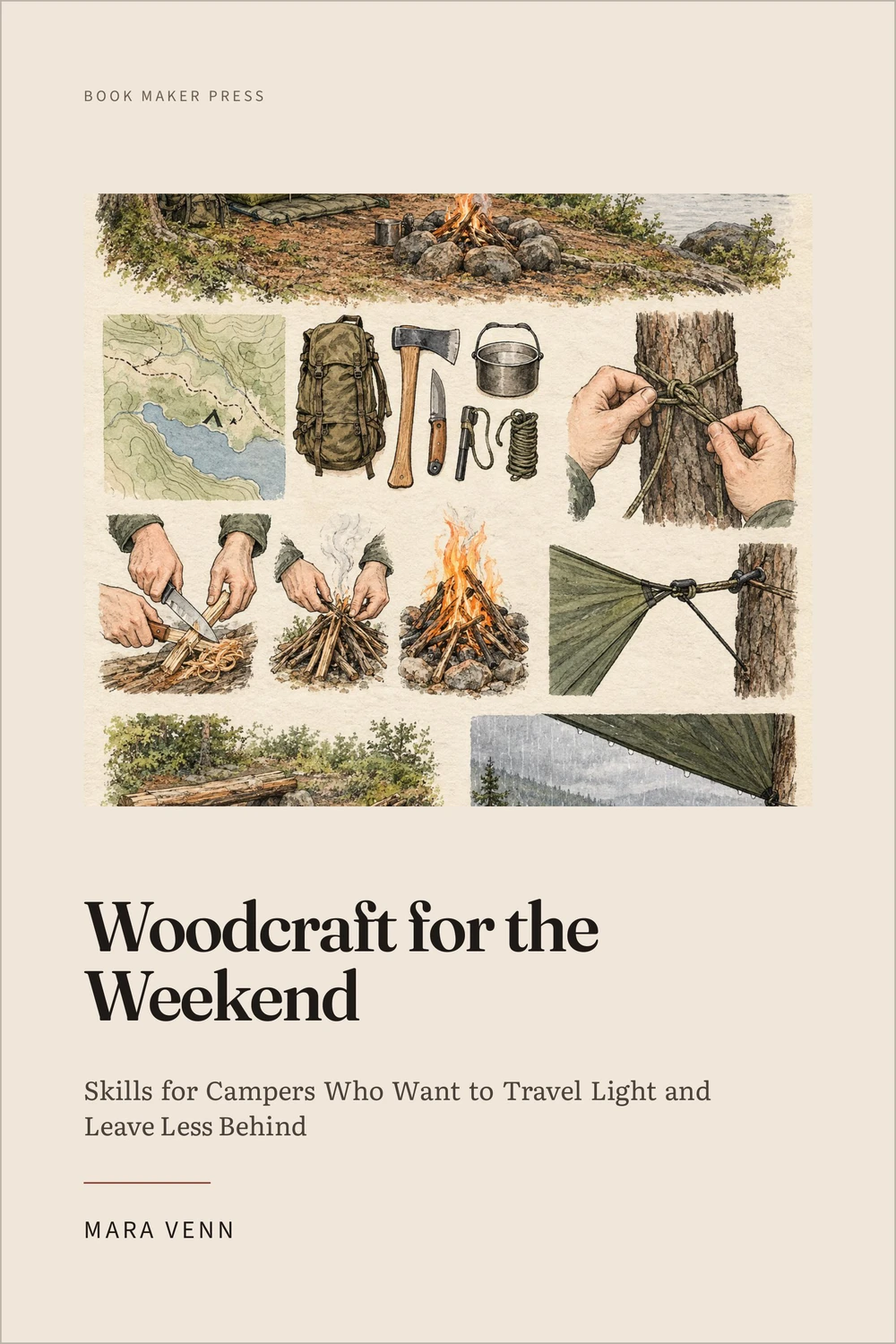
Plan, pack, and camp a two-night trip so Sunday afternoon feels the way you wanted.
The book opens with the question of what you want Sunday afternoon to feel like and closes with the four-line review you write at the takeout. Along the way it puts dry clothes ahead of knives, coals ahead of tall flames, and campsites chosen for their worst hour rather than their best view.
I planned a trip for a different person than me
The guidebook route has four portages, one of them a kilometer and a half over a ridge. The gear list has a bow drill you have never used, and the whole thing starts after a five-hour Friday drive. The first chapter has you count the new things on the trip and name the weekend you actually want before anything gets packed.
My knife is great and I was still shivering by four
That happens with a shell that was waterproof last spring, no insulation in a dry bag, and a forecast read as a promise instead of a range. The pack chapter orders gear the way a body gets into trouble: insulation, weather protection, footwear, and one dry change of clothes, ahead of every tool.
My camp falls apart by Sunday and leaves a mess behind
The tarp sags full of rainwater, the filter sits assembled on a log, the food canister is half buried, and everyone assumed someone else had noticed. The upkeep chapter attaches five-minute checks to arrival, sleep, and departure, and the impact chapter sorts sites by how much use the ground can take before it stops recovering.
From “Decide What the Weekend Can Hold”
The first question I ever asked on a course was not "what do you want to learn." It was "what do you want this weekend to feel like on Sunday afternoon." People usually had an answer, and it usually wasn't the trip they had planned. A woman named Dana, who arrived at a June canoe course with a kayak paddle she'd bought for a canoe, told me she wanted to sleep somewhere she couldn't hear a highway. She had circled a route in a guidebook with four portages, one of them a kilometer and a half over a ridge, because the book called it a classic. She had also read a magazine article about friction-fire methods and packed a bow drill she'd never used, in case. I asked her to count the new things on the trip, and she got to six and laughed. The canoe itself, which she'd paddled twice, and the portage terrain she'd never walked. The new paddle, the bow drill, a campsite she'd never seen. And a companion, her sister, who had told her plainly that she wanted to swim and read, not walk a kilometer and a half with a pack.
Dana's trip wasn't doomed. It was planned for a different person than the one going on it. The route suited someone building a season of trips. The gear list suited someone rehearsing a survival narrative. And the whole thing was supposed to happen in a weekend that began with a five-hour drive on Friday night. What she wanted, sleeping out of earshot of traffic, was available on a lake eight minutes from the put-in, at a campsite you could reach before dark and leave late on Sunday. The classic route is still there. It will still be classic when she has twenty paddle days instead of two.
This is the first decision of any weekend in the woods, and it comes before the gear, before the destination, before anything you buy or pack. Name the trip you actually want. Not the trip that would impress the people at work, not the trip the guidebook is selling, not the trip you'd be capable of if the weather held and your knee cooperated and everyone else turned out to be as keen as you. The trip you want, held against the time and people you actually have.
I think of weekend trips as falling into three rough categories, and the categories matter because they pull in different directions. Rest trips exist to lower your heart rate and let you sit by water. Practice trips exist to make one or two familiar things more fluent, or to introduce one new skill where failing at it is an inconvenience rather than a crisis. Ambitious trips make the route itself the point, and you accept that the weekend will be organized around effort. A trip can blend these, but it can't fully serve more than one, and most bad weekends I've witnessed came from a leader who thought the group had agreed on one category while everyone else had privately assumed another.
What is inside
16 chapters, 93,100 words.
- 1
Decide What the Weekend Can Hold
Opens with the question that sorts every trip, what you want Sunday afternoon to feel like, and has you count how many new things one weekend can honestly hold.
- 2
What Earns Its Place in the Pack
Ranks what goes in the pack by the order a body gets into trouble, putting insulation, weather protection, footwear, and one dry change of clothes ahead of every tool.
- 3
Read the Ground Before You Commit
Teaches route reading that starts where the map stops, from a ninety-rod portage that turned out to be a flooded beaver meadow to the hollows where cold air collects at night.
- 4
A Camp That Fits the Place
Walks a site before you claim it, checking where water would come from, what hangs over the places you might sleep, and where tonight's wind will come from.
- 5
Sleep Warm Without Building a Cabin
Treats sleeping warm as four parts that must work together, weather protection, body insulation, ground insulation, and dry clothing, and explains why the roof matters least.
- 6
Wet Fuel, Dry Sequence
Splits fire into four jobs, ignition, tinder, kindling, and fuel, all prepared before the flame exists, and starts with whether fire is permitted where you are standing today.
- 7
Tools That Bite Back
Asks what work the weekend requires before any blade comes out, argues that a knife under four inches and a folding saw cover most of it, and covers swing direction and sharpening at home.
- 8
Cordage That Has a Job
Sorts every camp connection into four jobs, hold, adjust, release, and bind, then matches knots and cord to each, down to what wet nylon does to breaking strength.
- 9
Water Has a Route
Replaces the assumption that the route will provide water with a sequence you can run, choose sources, collect, treat, carry, store, plus a tape band that marks dirty bottles.
- 10
Make Coals, Not a Bonfire
Builds the cooking fire backward from what the food needs, shows why a loose lay of five sticks beats a dense one of twelve, and moves the pot low and sideways rather than high.
- 11
Supper Is a Systems Test
Treats the evening meal as the test that shows whether the camp's systems hold together at once.
- 12
The Canoe Trip Includes the Carry
Starts with the route before any hull is compared, covering portage counts, who lifts the boat, how to lash the load, and the conditions check owed at every launch.
- 13
When the Plan Breaks
Teaches the first minute after a plan breaks, the pause, counting heads, and the rule that people get protected before equipment gets repaired.
- 14
Make Less Work for Tomorrow
Attaches five-minute checks to arrival, sleep, and departure, and gives every routine job a name so upkeep stops depending on memory.
- 15
Leave the Ground with Fewer Marks
Draws the line old manuals never needed, concentrate your use on ground already scarred, disperse where use is light, with the specifics of dishwater, wood rules, food storage, and food-conditioned animals.
- 16
Carry the Practice Home
Closes with a four-prompt review that separates the result from the method, and a four-stage progression for practicing skills before a trip depends on them.
Written for you if
- You camp on weekends and want the Sunday drive home to feel unhurried.
- You paddle routes with portages and want the boat, the pack, and the plan to match the carry.
- You want a lighter pack and fewer marks left behind, along with the reasons for both.
Woodcraft for the Weekend, $12
- EPUB and PDF, no DRM
- 326 pages, download right away
- Keeps in your library for good
- 30-day refund, no questions
Founding price until December 6, 2026, then $19.
Questions
On the same shelf
Woodcraft for the Weekend
Buy · $12