Outdoors · 422 pages · about 8 hours
Wild Competence
Field Judgment for the Hours When Plans Fail
by Mara Venn
Listen: The Trip You Can Explain
0:00 / 0:00 · narrated by a synthetic voice
$19 when the founding price ends inDec 6
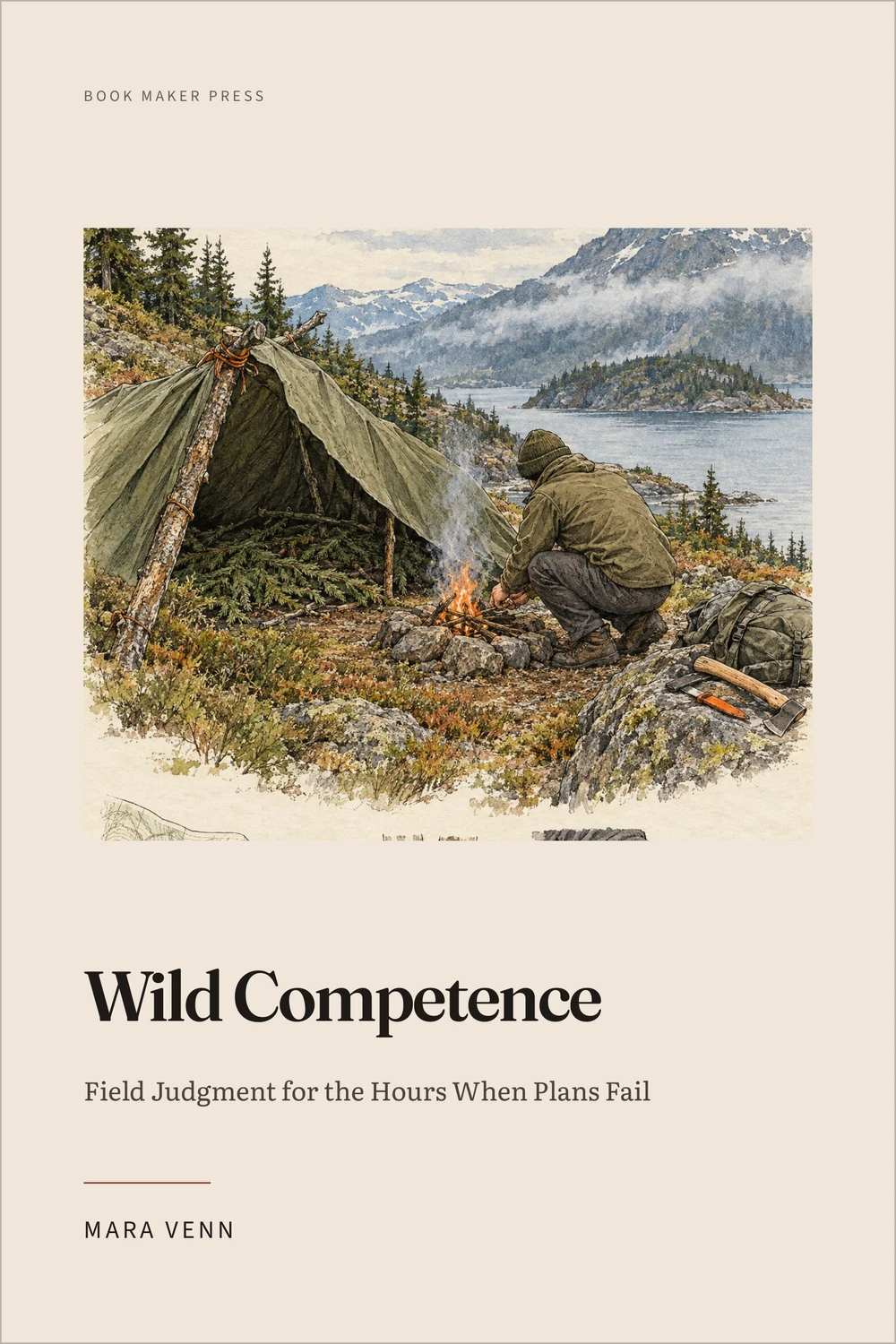
Wild Competence teaches the field judgment that decides how a broken plan ends.
Good plans fail for ordinary reasons: a missing trail sign, a crossing that rose overnight, a man shivering at lunch. The book trains the judgment for those hours, decision by decision, from the trip plan you leave with a friend to the choice of whether to build a fire at all.
My trip plan lives in my head and nowhere else.
When you are overdue, someone has to describe your trailhead, your truck, and your turn-around time to a dispatcher over the phone. This book shows how to write the short plan that person actually needs, and what a satellite messenger is worth if you have never sent a test message.
Nobody in my group says what they are thinking.
On one tidal crossing, a walker who had grown up on that shoreline disagreed with the leader and never said so, and the group crossed at ankle depth when it should have been dry. The book treats a group as equipment with a decision process, and shows how to agree on one at the trailhead in about five minutes.
My phone puts me on a trail that no longer exists.
At one junction, the sign, the app, and the blue dot all agreed, and the ground, a wall of alder and blown-down fir, disagreed with all of them. The book teaches you to check where you think you are against what the terrain will confirm, and to say out loud how you know.
From “The Trip You Can Explain”
The call came in on a Sunday evening in October, the kind of call a coordinator dreads because it contains almost nothing usable. A woman wanted to report her brother overdue from a day hike. He was fit, she said. He knew the area. She did not know which trailhead he had started from, only that he had said something about "the ridge" over dinner on Thursday, and that he had planned to be home by six. It was nine. She could not describe his truck beyond dark, maybe blue. She did not know whether he carried a map, a phone, or any sense of an alternate route.
We found him the next morning, cold and embarrassed, sitting beside a creek two drainages west of where anyone thought to look. He had taken a fork at a junction he did not remember seeing described, discovered his error an hour later, and decided that the sensible fix was to contour around a hillside rather than backtrack. The contour put him into terrain he could not get out of before dark. He spent the night pressed against a log with his jacket pulled over his knees, and he did everything else right: he stayed put, he kept warm, he waited for light. The search took eleven hours longer than it should have, not because he made a bad survival decision, but because nobody outside his head knew where his day was supposed to go.
That is who a trip plan is actually for. Not for you. You already know where you intend to walk. The plan exists so that a person sitting in a kitchen at nine at night, holding a phone, can tell a dispatcher something more specific than my brother went to the ridge.
I want to be plain about what I mean by a trip plan, because the phrase has been ruined by forms. It is not paperwork. It is a short, current description of where you are going, how you are getting there, when you expect to be out, and what a specific person should do if you are not. Some land managers publish a checklist for exactly this, and the ones I have seen ask for the same handful of items: who is going, what you are doing, your mode of travel, the route and any intended camps, identifying details of your vehicle or boat, and when you expect to be back. You can write that on one page. You can write it on half a page. What matters is not the completeness of the form but whether the person reading it could point at a map and say, start here.
What is inside
21 chapters, 121,000 words.
- 1
The Trip You Can Explain
How to write a trip plan for the person holding the phone at nine at night when you said you would be home by six: your trailhead, your route, your turn-around time, and what you would plausibly decide at each point where the day could bend.
- 2
Carry What You Can Use
A working rule for the pack: carry what you can use, and know what each item is for before you depend on it.
- 3
Read the Ground Before It Reads You
How to read washes, drainages, and contour lines as a plumbing system, starting with a wash that was dry at four in the afternoon and running like a freight yard at two in the morning.
- 4
When the Day Stops Going to Plan
What drift is and how to stop it, learned on a trail the author had walked forty times, where a missing sign and an overgrown tread sent a crew forty minutes the wrong way until one member asked when they had crossed the creek.
- 5
The Group Is Part of the Equipment
How to agree, before the trip, on how decisions get made, so a tidal bench gets crossed on one judgment instead of two private ones pretending to be one.
- 6
A Dry Place Is a Medical Intervention
Campsite selection in the order the author teaches it: screen for what kills quickly first, then what hurts slowly, then what is merely miserable, illustrated by a mossy shelf that was under six inches of moving water by morning.
- 7
Cold Is a Sequence of Small Losses
Cold stress as a sequence of small, preventable losses, and the group habit for a man shivering hard enough to rattle a thermos at a windy lunch stop: name the observation and propose the next action in the same breath.
- 8
Water Is a Route Decision
How to plan water as part of the route, after a bridge found in three pieces in a creek bed left two hikers with a little over a liter between them: mark every source you would bet on and decide what to do if the best one is dry.
- 9
Ignition Is Only the Beginning
The go or no-go decision that comes before the match, then the sequence that makes a fire work: tinder, graduated fuel, a lattice with gaps, and a cleared space, taught against the night a lighter clicked eleven times over wet cedar.
- 10
A Map Is a Conversation With the Terrain
How to hold a position you can defend from a second source, at a junction where the sign, the app, and the blue dot all agreed and the ground disagreed with all of them.
- 11
Movement Has a Price
Why moving is a purchase and stopping has a value, argued from a man found three quarters of a mile from a trail he knew, with the habits that price every step: named margins, thresholds rehearsed as conditions, and a pace set by the slowest person.
- 12
Make Yourself Easy to Find
What phones, satellite messengers, and beacons actually send and depend on, why an untested device is luggage with a hopeful label, and why a ridge at 4,000 feet can have service while the drainage below has none.
- 13
Care Begins With the Scene
Scene safety as a physical act of looking before your hands touch the patient, opened by a rescue that turned one injured hiker into two, then the field responses to bleeding and shock, including nothing by mouth when surgery is possible.
- 14
The Quiet Emergency
The ordinary illnesses that end trips, from a scraped cook pot of pasta salad that took four people out of nine to a blister that slowed a group of six for two hours, with prevention habits and firm rules on poisoning and unidentified plants.
- 15
When the Food Bag Runs Low
What to do when the schedule slips and the oatmeal is the whole breakfast: spend attention on the threat closing in fastest, put dry layers on the person with the ankle, and eat nothing you cannot positively identify as a species.
- 16
Meals, Fuel, and the Cost of Staying
Food planning by the standards of a pack rather than a kitchen: what two glass jars of pasta sauce and a cantaloupe cost by the second afternoon, meals checked against every person's allergies, and stove clearance that keeps a drying jacket out of the flame.
- 17
When Water and Weather Change the Map
Crossings and weather as map changers: why six inches of moving water can take an adult off their feet, how a creek rises from rain you never felt, and what to ask a steep snowfield before you step on it.
- 18
The Small Repairs That Keep a Trip Small
The repair habit that starts with four minutes of looking before the cord, plus work-area rules for tools, load checks when the pack settles, and the fixes that keep a broken zipper from costing a night.
- 19
Practice Without Pretending
How to practice skills as decisions in rain, wind, and cold hands, after a knot expert knelt in a puddle with one guy line and no memory of which corner it came from, plus a debrief that compares what you intended with what an observer saw.
- 20
The Line Between Resourceful and Reckless
The line between a trick that works once and gear that performs under load, opened by a tuna can stove that warmed water while its builder could not say what the can was lined with.
- 21
Come Back With Better Judgment
Low-impact practice as the same discipline of noticing and checking applied to the ground, opened by a driftwood fire ring that took three hours to dismantle, plus the honest debrief that turns a day hike that went fine into changes you keep.
Written for you if
- Day hikers and backpackers who want a plan that still means something when the trail, the water, or the weather changes.
- Trip leaders who need a group to agree on how decisions get made before the day bends.
- Experienced walkers and outdoor instructors who want their skills tested in wind, rain, and cold hands rather than in a backyard.
Wild Competence, $12
- EPUB and PDF, no DRM
- 422 pages, download right away
- Keeps in your library for good
- 30-day refund, no questions
Founding price until December 6, 2026, then $19.
Questions
On the same shelf
Wild Competence
Buy · $12