Outdoors · 402 pages · about 8 hours
The Far Shore
Judgment for Longer Coastal Journeys
by Mara Venn
Listen: Distance Is Not Difficulty
0:00 / 0:00 · narrated by a synthetic voice
$19 when the founding price ends inDec 6
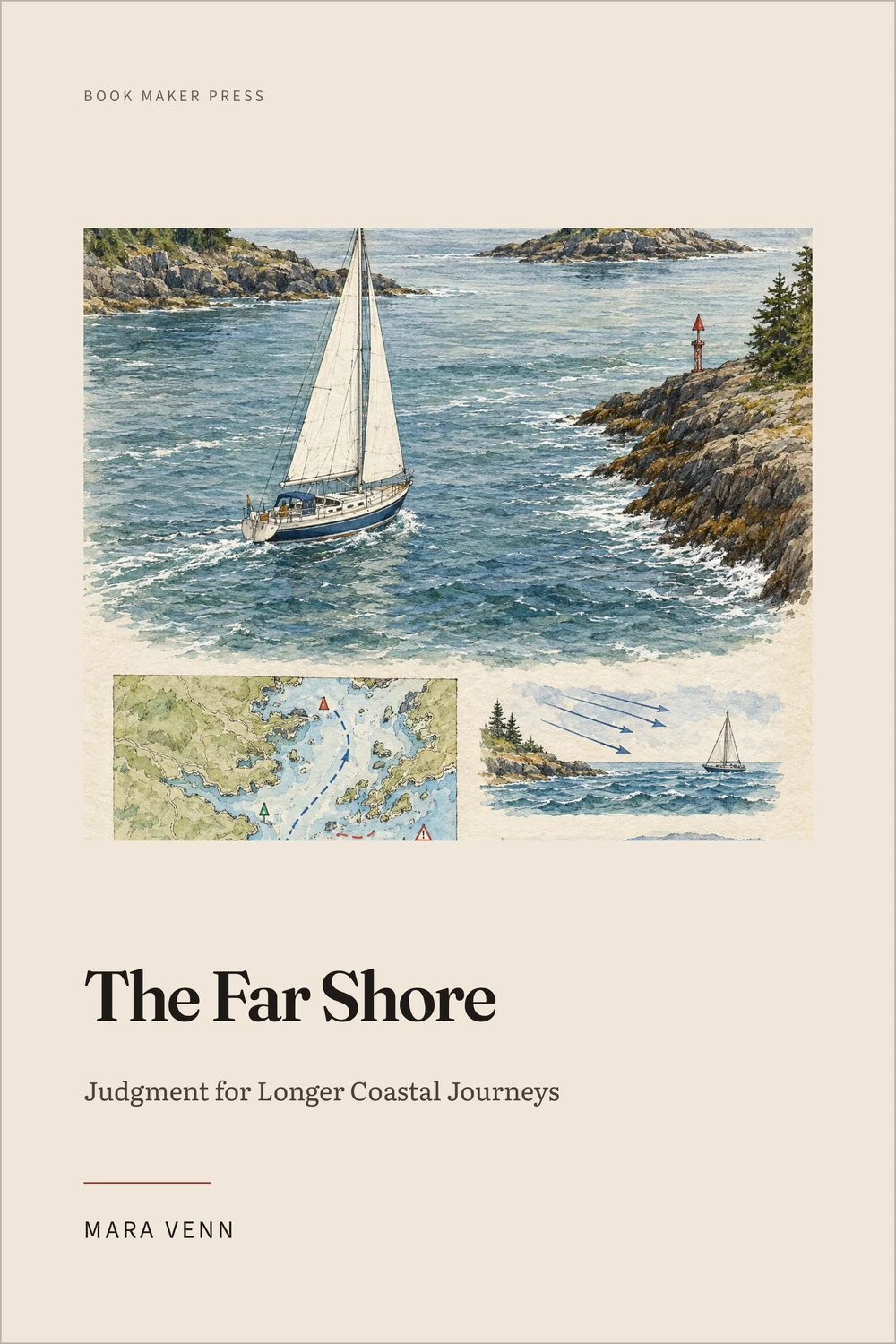
This book teaches the judgment that keeps long coastal journeys off the rocks.
The Far Shore is about the decisions before and during a paddling day: when to cross, when to wait, when to turn around. Each chapter takes a real planning failure and shows the habit that would have caught it.
The forecast said force four
One wind number can describe three different seas along the same two miles: ruffled moorings, a sheltered lee, and open water with forty miles of fetch behind it. This book shows how to translate a regional forecast into consequences for the specific water you will sit on at half past two.
The plan said three hours
A group leader divided nine kilometres by three and got three hours; the crossing took four and forty minutes. The book teaches honest speed estimates for your slowest paddler, clock limits written the night before, and decision points where lateness has a prepared answer instead of an argument.
Nobody wanted to say stop
Paddlers stay silent when raising a concern means arguing a case in front of five people. The book covers stop signals, turnaround rules agreed in the car park, and the specific sentence to write down so the water never has to be renegotiated while you are floating in it.
From “Distance Is Not Difficulty”
The crossing I think about most often when people ask me about route planning is one I never made. It appears on the chart of a coast I know well as a gap of just under two miles between a sheltered bay and a small cove with a beach that is pleasant in summer. On paper it is the obvious way to get from one place to the other. The alternative is five miles of paddling around a long headland, staying inside a series of small bays the whole way. I have watched groups look at the chart, measure the gap with a thumb and forefinger, and decide in about four seconds. The thumb says twenty minutes. The thumb is not lying about the distance. It is lying about everything else.
The two miles run past a shore of low cliffs and boulder fans for most of their length. There is no landing on that shore in the conditions for which anyone would want one. If the wind strengthens from the prevailing quarter while you are in the middle, it comes at you over open water with nothing to interrupt it, and it pushes you toward the cliffs you cannot land on. Turning back means turning your bow, or the group's bows, into that same wind and holding a line back toward the bay for roughly a mile, which is a different job entirely from drifting pleasantly across with the weather behind you. Five paddlers can make that crossing in twenty-five minutes in flat calm. In a force five from the wrong direction, some of them cannot make it back at all, and the ones who can will arrive at the cliffs rather than the bay if their ferry angle slips. I have stood on the headland above it in November and watched short wind waves break across the whole gap, white from side to side, and I have also crossed it in June on water like a pane of glass. Same two miles.
Different routes entirely.
This is the habit I want to break early, because it shapes everything else in this book: the belief that distance tells you how hard a trip will be. Distance tells you how far you will travel. It contributes to the demands of a trip, through time underway, fatigue, and how much food and water you carry. But it does not tell you what the trip demands of you, because difficulty in coastal water comes from a different set of ingredients: how long you are exposed to conditions you cannot easily escape, where you can land if something goes wrong or someone gets tired, what the tide and daylight allow and forbid, and what happens to your options if you are slower than you expected. A short crossing can carry more commitment than a long and nominally harder route, and the difference is not exotic. It is arithmetic and geography, available to anyone who looks.
What is inside
21 chapters, 116,700 words.
- 1
Distance Is Not Difficulty
Distance is not difficulty: why a two-mile gap past unlandable cliffs can be a harder route than five sheltered miles, and how to compare routes on exposure rather than miles.
- 2
The Coast You Actually Have
What a chart actually tells you, what it does not, and how to build a route from its real contents: restricted areas, landing options, and named waiting places with recheck dates.
- 3
A Forecast Is Not a Promise
How to read a marine forecast as a description of a region rather than a promise about your headland, and how to translate wind, rain, and visibility into exposure facts for your route.
- 4
Who Is Ready to Leave?
How to assess a paddler's readiness as a bundle of separate capabilities rather than a single number of years, and to match crew fitness to the specific demands of the route.
- 5
Tide Has a Direction
Tide versus current: why a tide table at one harbour tells you almost nothing about the stream in a channel four miles east, and how to plan around slack water and current tables.
- 6
Wind Gives the Water a Shape
How the same force four acts on three different waters in two miles, and how to read wind by where the shoreline stands between it and your boat.
- 7
The Landing Is Part of the Passage
Swell, wind waves, and why the landing is part of the passage: reading an approach from the water and comparing candidate landings before you commit.
- 8
The Crossing Has a Price
Crossing arithmetic done honestly: the slowest paddler's speed, coordination costs of a group, and windows with deadlines in both directions.
- 9
Two Ways to Know Where You Are
How to turn a chart line into a plan by cutting it into legs with their own references, so a position error is thirty minutes wide instead of four hours.
- 10
Equipment Should Buy Time
Why equipment should buy time, starting with clothing: dressing for the water you might enter, not the air you expect, and testing gloves against zips and radios before launch.
- 11
Cold Starts Before the Emergency
Cold as a slope rather than an event: how undramatic heat loss over an ordinary afternoon degrades paddling, decision-making, and noticing, and how scheduled stops fight it.
- 12
Small Errors Gather
How small errors gather: a worked crossing where a slower pace, a missed landing, and a cold paddler draw on the same reserves until the cheap responses are gone.
- 13
The Turnaround Is a Skill
Turnaround as an agreed skill: the car-park conversation, unconditional stop signals, and naming who gets to call a check before anyone is wet.
- 14
One Boat Is No Longer Moving
What to do when a trip becomes an incident: stabilize first, assign rescue roles before departure, and how to count heads when one boat stops moving.
- 15
Keep the Group Together Without Making It Rigid
Group cohesion as a chosen arrangement rather than a fixed shape, matched to visibility, wind, and the exposed or sheltered water you are crossing.
- 16
When the Coast Disappears
Fog and darkness as changes to the route: how to navigate when landmarks are withdrawn, run a position-check sequence, and keep sound signals working when shouting fails.
- 17
A Stop Can Be the Safer Route
When a stop is the safer route: assessing beaches from the water, reading wrack lines and drainage, and attaching stated conditions to every wait.
- 18
Make Yourself Findable
How to make yourself findable: float plans, shore contacts, and keeping the rescue document pointed at the coast you are actually on.
- 19
Rescue Is Not a Ride Home
When to call for assistance: the tests that separate a hard afternoon from a shrinking margin, and why once a crew is on scene their directions outrank everything you have read.
- 20
The Last Landing Still Counts
Why the last landing still counts: landfall as a decision point, watching the state you arrive in, and ending the trip with a deliberate landing rather than momentum.
- 21
Change the Next Departure
How to review a trip so luck does not grade itself as judgment: the skeleton of times, the disagreements, and the one finding worth carrying to the next departure.
Written for you if
- Sea kayakers planning multi-hour or multi-day coastal trips, especially with mixed groups.
- Trip leaders and club paddlers who want written plans that survive contact with tide and wind.
- Anyone who has finished a trip safely and suspects the outcome was luck rather than judgment.
The Far Shore, $12
- EPUB and PDF, no DRM
- 402 pages, download right away
- Keeps in your library for good
- 30-day refund, no questions
Founding price until December 6, 2026, then $19.
Questions
On the same shelf
The Far Shore
Buy · $12