Home · 264 pages · about 5 hours
The Unhurried Table
Home Cooking for Real Weeknights, Real Budgets, and Real Appetites
by Mara Ellery
Listen: Start With the People at Dinner
0:00 / 0:00 · narrated by a synthetic voice
$19 when the founding price ends inDec 6
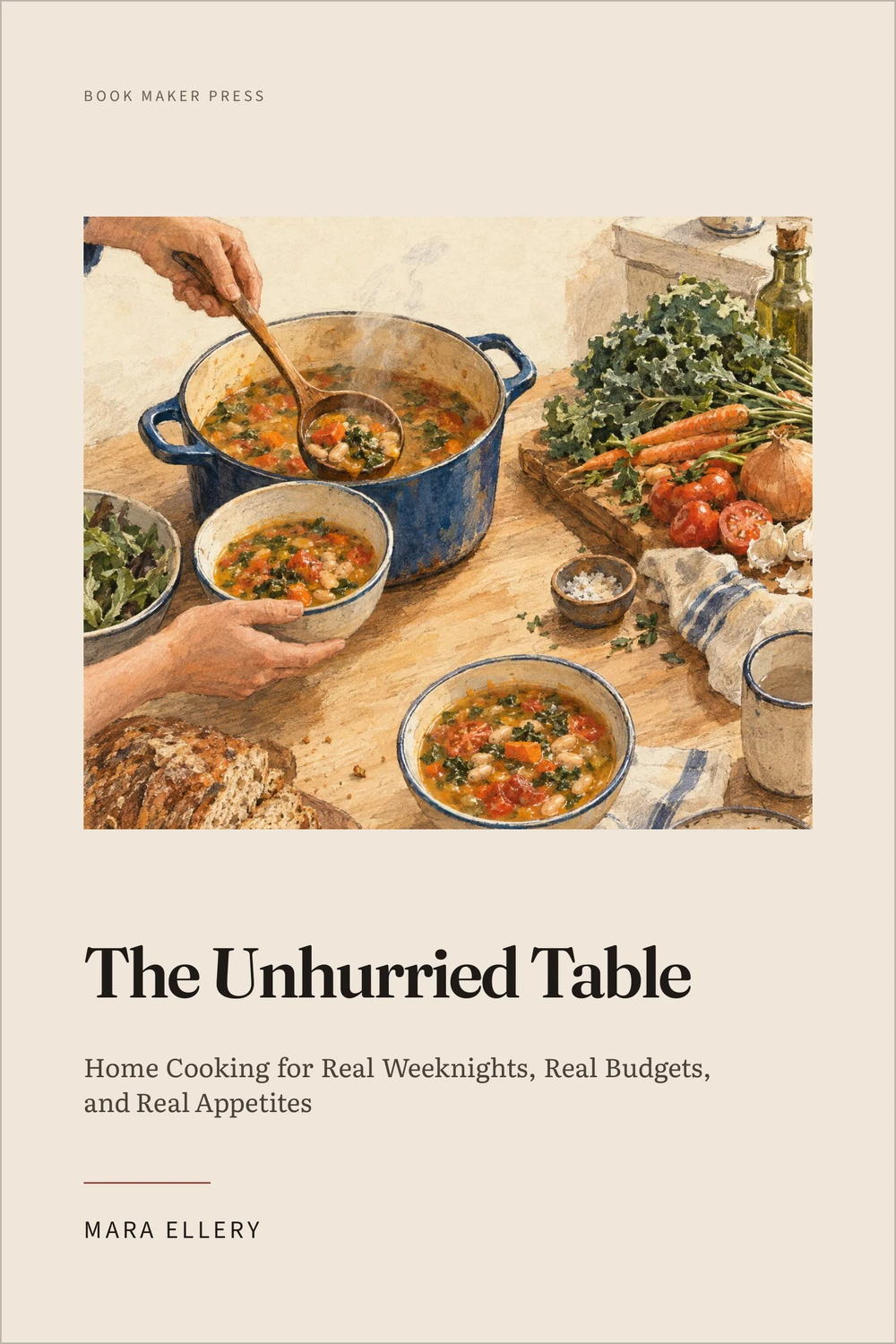
Cook dinner around your real schedule, real budget, and the people actually at the table.
It replaces the polished weekly menu with methods built for the week you actually have, where the bus runs late, the overtime lands the day of, and the grocery money is fixed. You get base pots that finish differently for each eater, a pantry stocked by what your household really eats, and honest arithmetic on what a big batch costs when a third of it ends in the compost.
My meal plan falls apart by Thursday.
You sketch seven dinners at six o'clock, then Thursday's overtime lands and the grid collapses, because it was built as a promise. The book starts from the week as it actually runs, with one slot left blank on purpose to absorb the changes.
I cook four different dinners every night.
One eater refuses anything with sauce, one stopped eating meat that autumn, one's list of acceptable foods keeps shrinking, and the cook eats what is left, standing up. The book replaces separate complete dinners with components combined at the table: a grain, a tray of roasted vegetables, a pot of beans, a mild sauce, and hot sauce on the side.
Good food costs more than I can spend.
The meat wedge on the standard plate poster is the part a pension cannot cover, and the thrift guides treat the labor of stretching a chicken as if it were free. The book treats protein as a job on the plate rather than a nutritional requirement, and shows how a hambone in split pea soup or anchovies melted into oil carry a whole pot from a small amount.
From “Start With the People at Dinner”
The clipboard came back to me with the week filled in wrong. Not wrong in the sense of inaccurate. Wrong in the sense that it described a household I did not recognize, and I had been standing in that household's kitchen twenty minutes earlier. This was a Tuesday-night class at the library branch on Harrow Street, the one where the room divider never quite closes and the radiator bangs at unpredictable intervals. I had asked everyone to sketch their week: meals, work, pickups, the parts in between. A woman named Dolores, who had told us earlier that she worked rotating shifts at a care facility, handed back a grid with dinner at six o'clock every night, seven days a week, labeled in careful pencil.
I asked her about Thursday, when I knew she was on until eleven. She looked at the paper for a while. "I put what it's supposed to look like," she said.
I have thought about that sentence for years. Supposed to look like. Somewhere between her actual life and her pencil, a translation had occurred, and the translation ran in one direction only: toward a week that no real person was living. Every polished menu I have ever seen operates on the same translation. It shows dinner at a consistent hour, cooked by a person with a consistent body, served to eaters with consistent appetites, in a kitchen that never runs out of counter space. It is a document of intent, and intent is the easy part.
The alternative I want to describe is less flattering but more durable. Instead of starting with meals, start with the week as it happens. Not the week you plan to have, not the week the cookbook cover implies, but the one where the bus is late on Wednesdays and the teenager has practice until seven and one adult finds out about Thursday's overtime the day of. This is a picture of constraints, not a test of how organized you are. I want to be clear about that distinction, because planning exercises have a bad habit of turning into audits. The grid is not asking whether you measure up. It is asking when you are actually standing in the kitchen with enough left in you to cook, and when you are not.
What is inside
13 chapters, 77,900 words.
- 1
Start With the People at Dinner
You sketch the week you actually live, including who carries the planning, shopping, and cleanup, before choosing any food.
- 2
A Pantry Is a Record of Decisions
You stock the pantry by what actually moves in your kitchen, keep a use-first bin in sight, and buy the big bag only when your weeks contain the big bag.
- 3
Learn the Moves, Not the Menu
You learn methods instead of menus, with ingredients described by the job they do and doneness judged by tasting, since one trial of common beans ran from nineteen minutes to well over four hours.
- 4
The Meal That Can Change Its Mind
You build base dishes, like a pot of beans with vegetables, a grain pot, or a roasted tray, that stay plain in the middle and take their variation at the end, with dried spices early and fresh herbs late.
- 5
One Pot, Three Different Evenings
You get the arithmetic of big batches: how much the household will actually eat, portions labeled for meals, and a destination planned for thawed beans, since freezing softens them.
- 6
The Dinner With More Than One Answer
You set out components, grains, vegetables, proteins, sauces, that each eater combines at the table, with a clear line drawn between preference and medical need.
- 7
Vegetables Without the Lecture
You choose fresh, frozen, or canned by fit for tonight rather than rank, with the frozen-produce nutrition findings stated alongside their limits and the pan adjustments frozen vegetables need.
- 8
Protein Without a Centerpiece
You separate the job on the plate from the meat that usually fills it, learning how a hambone in split pea soup or a smoked turkey wing in a pot of greens feeds a table from a small amount.
- 9
The Sauce Is the Shortcut
You learn correction as a few small moves with acid, salt, or dilution, each followed by a taste, so the same pot of beans stops being repetition and becomes a base.
- 10
The Glut Is a Scheduling Problem
You meet the sack of eleven zucchini by sitting down and sorting first, matching the produce to your real calendar, with the botulism and pH 4.6 facts for anyone who cans.
- 11
The Freezer Has a Front Row
You organize the refrigerator and freezer for retrieval: a front row for what needs using soon, flat-packed portions labeled with what and when, and no mystery bags.
- 12
The Kitchen Has a Labor Budget
You count cleanup in the cost of every technique and name who actually does the planning, shopping, cooking, and washing, on a list the whole household can see.
- 13
Leave Room at the Table
You feed nineteen guests, an uncle who avoids pork, a niece who stopped eating anything with a face, and a grandmother who brings her own plate, by setting out bowls in parts instead of one polished menu.
Written for you if
- For the cook with shift work, school pickups, and a grocery number that has to hold.
- For households where the eaters disagree and one person carries the cooking.
- For anyone who wants methods and honest arithmetic instead of another polished menu.
The Unhurried Table, $12
- EPUB and PDF, no DRM
- 264 pages, download right away
- Keeps in your library for good
- 30-day refund, no questions
Founding price until December 6, 2026, then $19.
Questions
On the same shelf
The Unhurried Table
Buy · $12