Home · 271 pages · about 5 hours
The Lost Skills of a Self-Reliant Home
Practical household skills for outages, hard times, and everyday peace of mind
by Etta Mae Ransome
Listen: The House on an Ordinary Tuesday
0:00 / 0:00 · narrated by a synthetic voice
$19 when the founding price ends inDec 6
Run a household that holds together when the power, the water, or the shops fail.
An eleven-minute outage is enough to show what a household is missing. This book starts where readiness actually begins, with the ordinary Tuesday you already know by heart.
My pantry is full of food nobody eats
You bought what a list said a prepared household should keep, and the jars are still sitting there years later. The book has you start with the meals you actually cook, then build the shelf around them, one piece of paper at a time.
I would not know what to do first in an outage
The first hour is about people and hazards, and the book gives you the order: who is accounted for, what can hurt somebody, what the official word is. The questions you want answered at 9 p.m. in the dark get answered in October instead.
I keep patching the same ceiling stain
A mark on the ceiling is the receipt for a problem, and paint hides the receipt while the account keeps running. The book teaches you to find the cause first, then shows which small repairs are yours to make and which belong to a professional.
From “The House on an Ordinary Tuesday”
Last March the lights went out at half past six in the evening, just as I was getting a casserole into the oven. The outage lasted eleven minutes. In that time I learned three things about my own kitchen: that I keep the flashlight in a drawer I cannot reach without the electric can opener in the way, that the batteries in that flashlight had been dead since sometime before Christmas, and that I had no idea where the nearest working candle was. Eleven minutes. I taught household readiness for a living for thirty years, and my own house fumbled a blink.
That is why I want to begin this book with an ordinary Tuesday and not with a storm. The trouble with starting from a catastrophe is that a catastrophe is somebody else's weather. It belongs to the news, and it puts a person in the frame of mind of watching rather than looking. But an ordinary Tuesday belongs to you. You already know it by heart. You get up, you put water on for coffee, you take a pill, you feed the cat, you run the tap, you check the weather on the phone, and somewhere in the day you or somebody drives to the store. Nothing about that list feels fragile. That is exactly why it is the right list to examine, because every item on it runs on something, and the something is usually invisible until it stops.
So pick a real Tuesday. Not your best day and not your worst. Yesterday will do, if yesterday was ordinary. Now walk through it slowly, the way you would walk a fence line, and each time you do something, ask what stands behind it. I mean that literally. What stands behind the coffee is electricity, or propane, or the woodstove, and behind the electricity is a line that comes down a particular hollow on particular poles, maintained by people you have never met. Behind the pill is a pharmacy, a prescriber, and a supply that runs out on a schedule. Behind the tap is a well with a pump, or a municipal system with a treatment plant and a crew. Behind the weather check is a phone, a tower, a signal, and a charge in a battery. None of this is alarming on a Tuesday. The point is only to see it.
When I taught the canning classes, I used to ask people where their food came from, and the honest answers were usually short: the IGA, the Foodland, a garden in season. Then I would ask what stood behind the IGA, and the room would go quiet in a thoughtful way, not a fearful one. A grocery store in a small town gets its deliveries by truck over roads that ice up and wash out. It keeps its milk cold with compressors that hum all night. It takes payment through a card reader that needs a signal. That is not an argument against the grocery store. I shop at mine gladly and I know the cashiers by name. It is only an acknowledgment that a familiar routine is not the same thing as a guaranteed one.
What is inside
14 chapters, 80,400 words.
- 1
The House on an Ordinary Tuesday
You trace one ordinary Tuesday, item by item, to see what stands behind your coffee, your pills, and your lights.
- 2
A Pantry That Earns Its Shelf Space
You build a pantry from the meals you actually cook, then plan the lifting, the rotation, and a one-page reserve list taped inside the door.
- 3
Water Is the First Household Calculation
You find your water's point of failure, from source to shutoff, and learn where to store a reserve and how to follow a boil-water advisory.
- 4
Grow the Patch You Can Keep Up With
You walk your own ground before ordering seeds, checking sun, slope, and spigot distance, so the garden fits your yard and your hours.
- 5
The Jar Is a Safety Decision
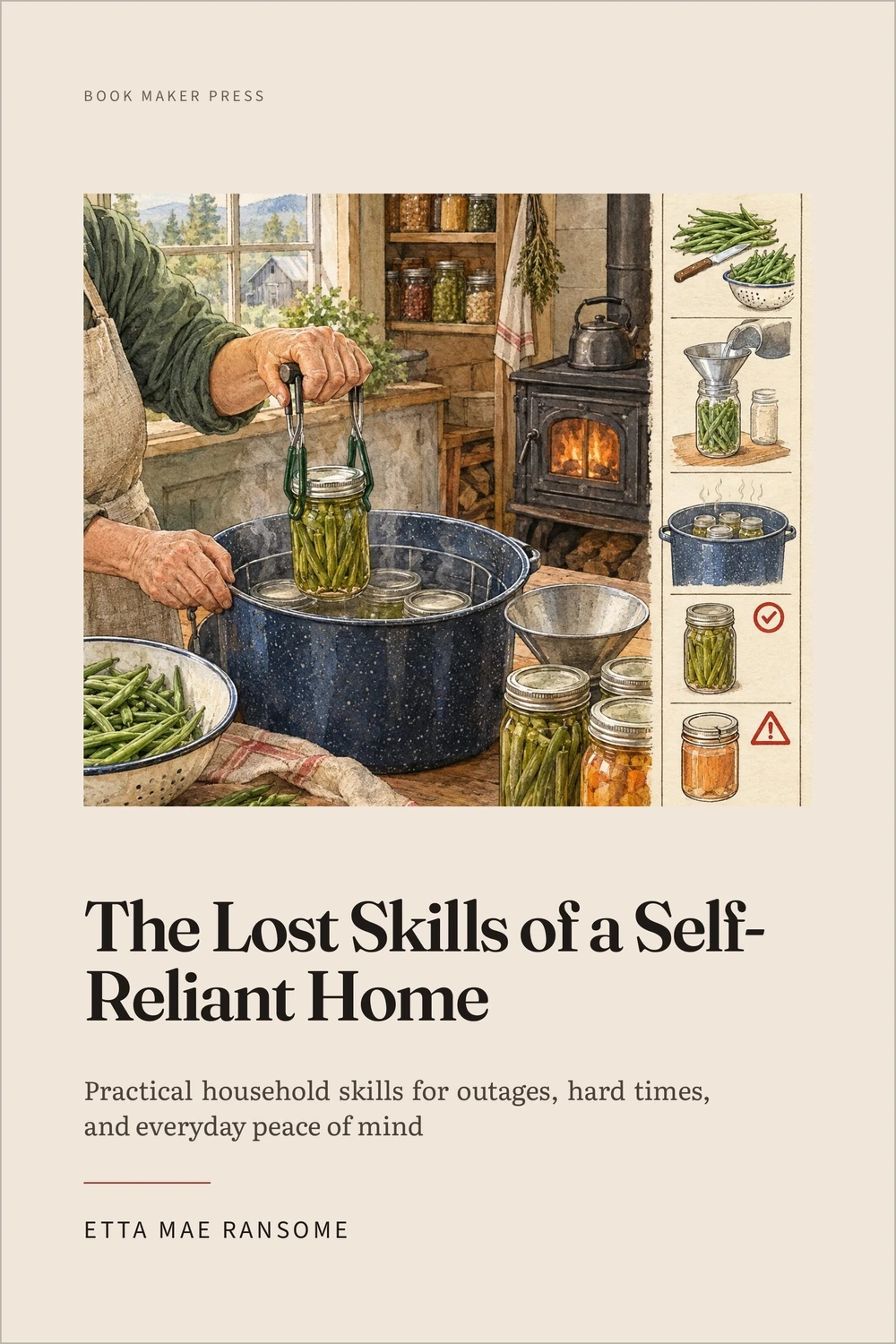
You learn why acidity decides the canning method, why green beans require a pressure canner, and how a one-dollar log replaces folklore.
- 6
Choose the Preservation That Fits
You learn drying, pickling, and freezing with the same discipline, including how to condition dried food and why a freezer needs a thermometer and an inventory.
- 7
Dinner When the Range Is Off
You write a short list of no-cook and backup-stove suppers, test every can and jar with your own hands, and keep every fuel-burning thing outdoors.
- 8
Keep Warm Without Making the House More Dangerous
You find the drafts with the back of your hand, work with curtains and sunlight, get the chimney swept, and learn what must never heat a room.
- 9
Thrift That Protects Tomorrow
You put your money somewhere it can be seen before it forces a decision, and you weigh a project's real costs, including your own afternoon.
- 10
Repair What Still Has Good Years in It
You sort the mending pile with three questions, tell local damage from worn-out cloth, and learn when buying new without guilt is the thrifty move.
- 11
Small Repairs, Clear Limits
You find the cause before the fix, learn which repairs are within reach, and know when a soft spot or a gas smell means call somebody.
- 12
A Forecast Is Not a Household Plan
You write a plan that fits your door: who checks what, an out-of-area relay contact, a meeting spot, and a place for the dog in it.
- 13
The First Night Without the Usual Systems
You practice the first night in advance, checking on people before property, and you reassess the stay-or-go decision more than once.
- 14
The Work After the Warning Ends
You learn what to do when you arrive home after a storm, which three numbers to keep on paper, and how a neighborhood list keeps the whole thing alive.
Written for you if
- You want your house to run steadier on an ordinary Tuesday, not just during a storm.
- You cook, garden, can, or mend a little and want the habits that make those efforts count.
- You are done buying gear out of vague worry and want to make decisions on purpose.
The Lost Skills of a Self-Reliant Home, $12
- EPUB and PDF, no DRM
- 271 pages, download right away
- Keeps in your library for good
- 30-day refund, no questions
Founding price until December 6, 2026, then $19.
Questions
On the same shelf


The Lost Skills of a Self-Reliant Home
Buy · $12