Work & Craft · 298 pages · about 6 hours
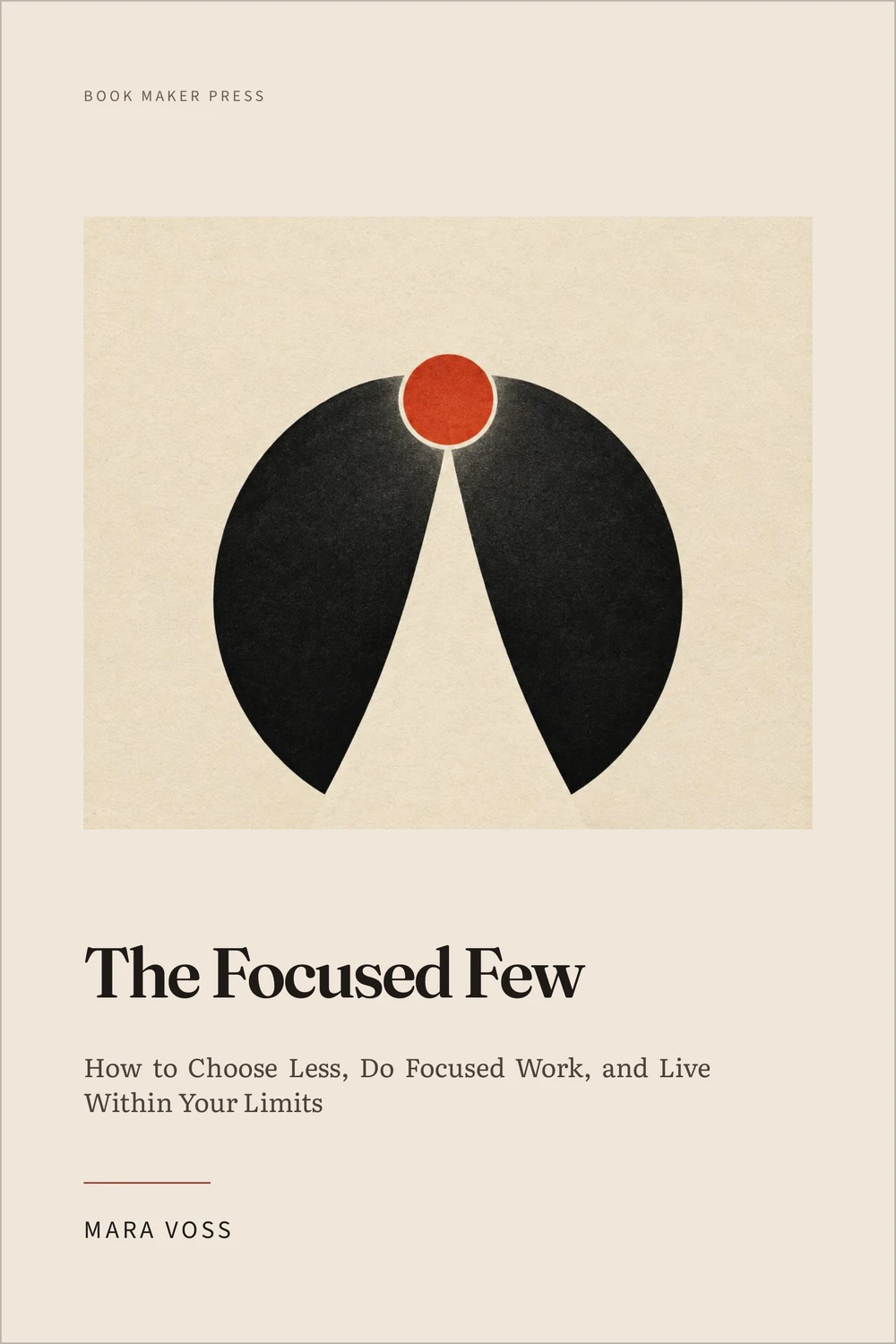
The Focused Few
How to Choose Less, Do Focused Work, and Live Within Your Limits
by Mara Voss
Listen: You Cannot Outrun Your Limits
0:00 / 0:00 · narrated by a synthetic voice
$19 when the founding price ends inDec 6
Cut the commitments you never chose, and spend the freed hours on work that counts.
Mara Voss treats attention as equipment with load tolerances and opens by doing the arithmetic your calendar has never done. The result is a working method for choosing fewer goals, refusing what merely insists, and building days that survive contact with a real Tuesday.
I'm always busy, but nothing ever gets finished.
A senior engineer in the book logs a twelve-hour day and finds less than two hours of demanding, heads-down work in it. The rest went to meetings, messages, and a status call about the status calls. Chapter 8 hands you the same printed grid so you can count your own focused hours before changing anything.
I can't say no without agonizing over it.
A software engineer in the book declines a recurring status call she has no stake in, drafting the message twice and rehearsing it in a parking lot first. The director replies 'no problem,' yet she spends two days certain he hates her. Chapter 6 explains why refusal feels dangerous when it costs nothing, and gives scripts for stating a real constraint without a fake excuse.
I keep things going because I've invested too much to stop.
A three-year data platform with eleven users, built to serve six hundred, survives a quarterly review because 'we've come too far to stop' sounds like prudence. Chapter 7 takes the phrase apart, reverses the usual burden of proof so that continuing has to earn its place, and offers the reverse pilot: suspend the commitment, tell the people who depend on it, and watch what happens.
From “You Cannot Outrun Your Limits”
Dana's Tuesday starts at six forty with a message from a client in another time zone. She reads it in bed, which she knows is a mistake, and then spends twenty minutes composing a careful reply, which she later redoes at her desk because typing with your thumbs at dawn produces its own genre of error. She has two kids, one of whom needs a permission form signed and physically handed to a human being, which Dana discovers at seven fifteen. Breakfast, backpacks, a bus that comes at seven fifty whether or not the permission form is found. It is found, at seven forty-eight, under a fruit bowl.
Her workday officially runs from nine to five thirty. Here is what is actually in it. A standing team meeting, forty-five minutes. A client call, thirty. A backlog review, twenty. Lunch at her desk, which does not count as a break and does not function as one. Roughly forty messages across two channels, a third of which require a decision rather than an acknowledgment. A colleague's code review that only she can do, scheduled for two hours. And a deadline, Thursday, for a market analysis that needs real concentration: reading source material, holding comparisons in her head, noticing where the numbers don't support the story someone wants to tell.
Suppose, generously, that the meetings, the messages, and the review consume six hours of her eight and a half. That leaves two and a half hours for the analysis. The analysis realistically needs eight. She will attempt to get them from somewhere, and the somewhere is always the same place: the evening, the edges of sleep, the attention she was going to spend on her actual life.
This is the arithmetic, and I want to be blunt about what it shows, because the culture around us is invested in not seeing it. The hours in a day are fixed. They are fixed the way the load rating on a bridge is fixed: not as a challenge, not as an insult, but as a physical fact that exists prior to anyone's ambition. Out of those fixed hours, several categories of demand are drawing on the same balance. Paid work is one. Coordination, the meetings and messages that keep work from unraveling, is another. Care, for children or parents or the friend whose crisis lands on the wrong week, is another. Rest is another, and rest is not a luxury; it is the maintenance schedule for the machine doing all the other things. And concentrated effort, the kind of work that actually produces something new, competes for whatever is left.
What is inside
12 chapters, 85,300 words.
- 1
You Cannot Outrun Your Limits
Adds up a project lead's Tuesday hour by hour and shows that the gap between the work her role needs and the hours her calendar holds was built into the schedule itself.
- 2
Choosing Is Your First Real Work
Traces how a working life gets assembled through small deferrals, and makes the distinction between having options and exercising choice the foundation for everything that follows.
- 3
Fewer Goals, Deeper Stakes
Dissects a product manager's list of defensible commitments, shows why two simultaneous goals cost more than twice one, and teaches backward tracing from a ten-year aim down to today's first step.
- 4
Making Room to Think
Takes up where the hours for thinking come from, and shows how room for concentrated work gets made on purpose rather than found.
- 5
Seeing What Actually Matters
Explains why attention goes to what shouts rather than what matters, teaches the habit of asking what is missing, and offers the index card as a cheap instrument for seeing patterns that memory will not hold still.
- 6
Saying No Without Burning Everything Down
Takes seriously why a harmless refusal can feel like a threat, then supplies scripts, stated constraints, and an escape valve so a no-policy survives the first genuine emergency.
- 7
Quitting the Wrong Things on Purpose
Puts 'we've come too far to stop' on the table as a reasoning error dressed up as grit, and hands you the reverse pilot for testing whether a commitment deserves another quarter.
- 8
Designing Days for Depth
Starts from a planning range of one to four hours of concentrated work a day, then shows how to protect two blocks, design the entry and exit routines, and treat recovery as part of the work.
- 9
Progress That Survives Real Life
Confronts the planning fallacy with the thesis study's numbers, about twenty-seven days estimated against fifty-five and a half actual, then shows how to build slack, name it, and defend it from the commitments that want to eat it.
- 10
Attention in the Moment
Draws on the author's attention experiments to show where the mind goes during a dull task, and teaches routing instead of suppression: record the intrusive obligation, give it a next step and a time, and return to the sentence.
- 11
Ambition Without Self‑Destruction
Retires the pie chart picture of balance, argues for named seasons of intensity with written thresholds, and tells you what the actuarial neighborhood looks like before you move in.
- 12
A Life That Chooses Back
Shows why a technique survives only when it expresses something its owner believes, walks you through writing commitments you can actually check on a Wednesday, and closes with a caution against turning choosing into another system to optimize.
Written for you if
- For professionals whose calendars filled up one accepted invitation at a time.
- For managers who want the priorities on the whiteboard to receive actual hours.
- For ambitious readers willing to retire good goals so the best work gets done.
The Focused Few, $12
- EPUB and PDF, no DRM
- 298 pages, download right away
- Keeps in your library for good
- 30-day refund, no questions
Founding price until December 6, 2026, then $19.
Questions
On the same shelf
The Focused Few
Buy · $12