Body & Age · 459 pages · about 9 hours
Longer and Stronger
A Practical Plan for Strength, Independence, and Health After 60
by Franklin "Frank" Dwyer
Listen: The Errands That Matter
0:00 / 0:00 · narrated by a synthetic voice
$19 when the founding price ends inDec 6
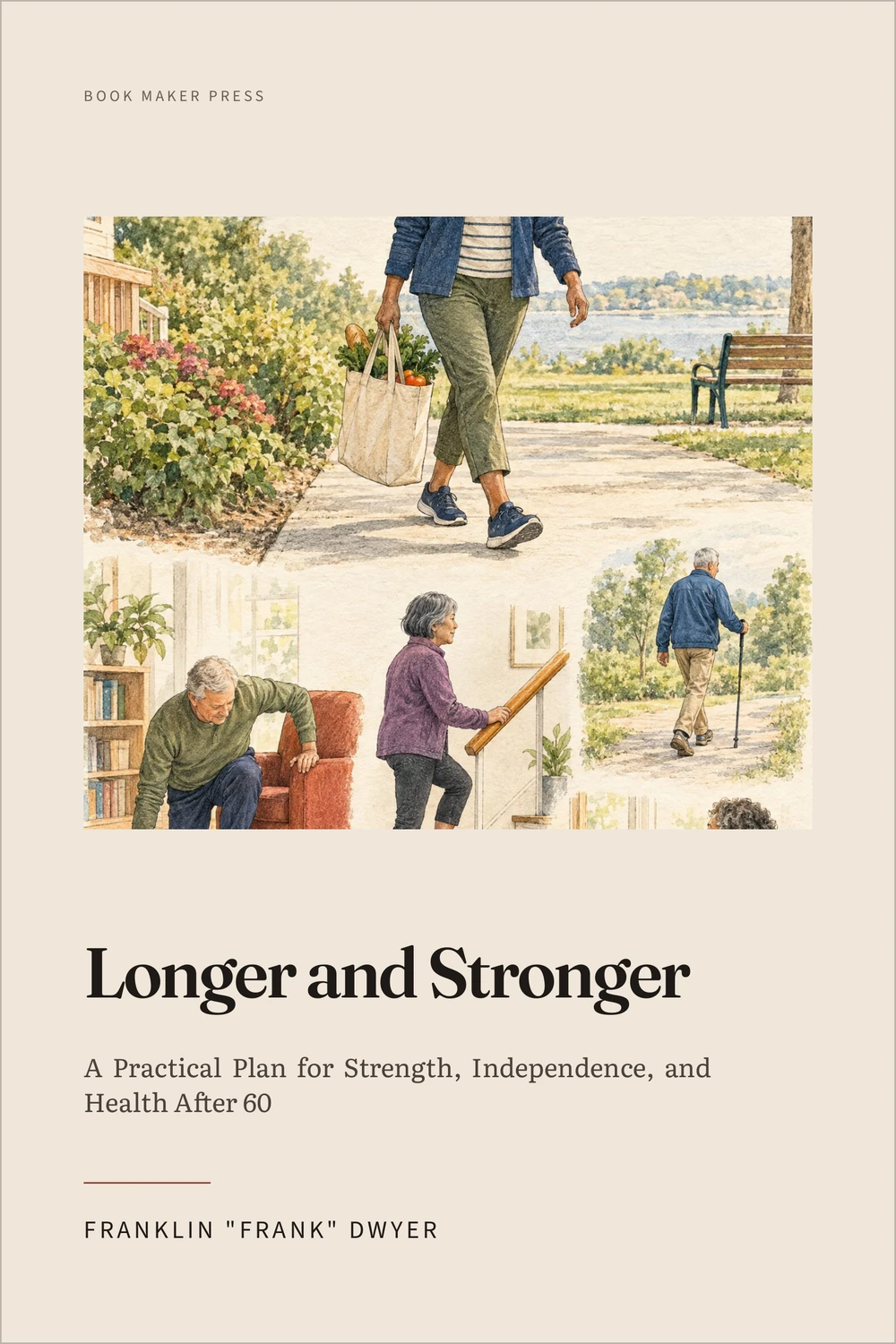
Build the strength that keeps you in your own house, from chair rises to grocery runs.
The yardstick here is what your body lets you do in the life you actually have: two grocery bags, a car door, a kitchen counter eight steps from the garage. Across 24 chapters the book works from chair rises and walking routes to floor skills, sleep, and the appointment where your ordinary life belongs on the table.
I've done this chore for ten years, and suddenly I can't.
Walt hung the birdseed every morning for a decade, and then his arm went flat mid-lift with no fall and no accident. The book teaches you to spot the changes you have already worked into your routine, like switching hands or resting the bag halfway, and to name them before they pick the morning they become an injury.
New sneakers in January, back of the closet by March.
The VFW walking group doubles the first Saturday of the year and is back to its usual dozen by the second Saturday of February, usually after a first walk that cost a week of soreness. The fix in chapter 4 is a start deliberately below your maximum, sized so you could do it again tomorrow without complaint, and Earl's first post office walk, which ended at the bridge and cost him the rest of the day in his chair, shows the bill for skipping that advice.
I say I'm fine at appointments and never mention the hill.
Walt stopped going to his granddaughter's softball games over a grass slope from the parking lot to the dugout, and it never came up with either of his two doctors. Chapter 18 puts your ordinary life on the table alongside your blood pressure and gives you the sentences and the one-page pill list to make the appointment actually move you forward.
From “The Errands That Matter”
Every Tuesday, a woman named Doris drives herself to the Giant Eagle in Kittanning and buys one week of groceries. She is eighty-one. She parks close, walks in with a short list, and comes back out with two bags, one in each hand, because two balanced bags are easier for her than one heavy one. Then she sits in the car for a minute before she drives home, and she told me once that this is her favorite minute of the week.
Nobody hands her a trophy for it. There is no score, no chart, no before-and-after photograph. But if you ask me what healthy aging actually looks like, I will point at Doris carrying those two bags across a parking lot in November. Not at a marathon. Not at somebody's idea of a perfect diet. Two bags, a car door, a kitchen counter eight steps from the garage.
I spent twenty years in Army physical therapy clinics, and I will tell you what I learned there, though it took me a while to apply it to myself. The measure that matters is not what a machine says about your body. It is what your body lets you do in the life you actually have. The clinics were full of soldiers who could pass a fitness test on Monday and could not climb the stairs to their barracks on Wednesday because of a knee they twisted on a night march. The reverse was also true. I worked with men in their fifties, broken in various ways, who fought their way back to ordinary things like carrying a rucksack or standing through a formation. When they talked about what they wanted back, none of them mentioned a number, because what they talked about was tasks, doing things, being present.
That is where I want to start this book, because I think it is where any honest book about staying capable has to start. Not with lifespan. Not with some distant target of years lived. With the errands that matter.
What is inside
24 chapters, 140,800 words.
- 1
The Errands That Matter
Opens with Doris, eighty-one, carrying two balanced grocery bags across a Kittanning parking lot, and argues that the measure that matters is what your body lets you do in the life you actually have.
- 2
Start Where Your Feet Are
Turns the starting point into a written inventory rather than a pass-fail test, recording what you can do now and the tasks you have already altered, like sliding the laundry basket instead of carrying it.
- 3
The Trouble That Builds Quietly
Uses Walt's shoulder giving out after ten years of birdseed duty to show how small losses accumulate behind years of workarounds, and introduces reserve as the gap between what you can do and what a bad week demands.
- 4
Make the First Step Boring
Explains why the walking group doubles the first Saturday of the year and returns to its usual dozen by the second Saturday of February, then builds the case for starting small on purpose, with Earl's walk that ended at the bridge as the cost of ignoring that advice.
- 5
Progress You Can Notice
Defines functional progress as a change that makes an everyday activity easier or safer to repeat, from the cellar stairs to the gravel driveway, and covers what a drugstore scale, a wrist tracker, and a kitchen-table blood pressure cuff can each honestly tell you.
- 6
The Strength to Stand Up
Teaches chair rises and wall push-ups as pieces of household jobs, shows the research knobs that raise or lower the difficulty of a rise, and separates steady muscle effort from warning signs like one-sided pain, dizziness, or chest pressure.
- 7
Legs for the Unexpected
Frames leg work as reserve for the day the rug slides or the parking lot gravel rolls, and covers why a setup that fits the person, plus honest limits on power training claims, beats blaming determination.
- 8
Balance Is a Practice
Presents balance as something you continuously do rather than something you own, with a counter sway drill for while the coffee brews, advice on having a helper nearby, and a caution that a good one-legged stance earns you nothing permanent.
- 9
Walking That Fits Your Tuesday
Treats a walking route as a tool that either fits your street and your day or gets skipped, using Margaret's blind curve as a design problem, and adds a conversation check for effort with cautions about medications that distort it.
- 10
A Heart That Can Keep Up
Separates short efforts like chair rises and curbs from stamina jobs like a full grocery run or a twenty-minute pharmacy line, and shows how to build the capacity that does not end with an hour in your chair.
- 11
Move Well Enough to Return
Uses Rose's three missed Saturdays to take apart the invented arithmetic that turns a lapse into a quit, and provides plan B routines for colds, travel, and sick family while sending real symptoms to your doctor.
- 12
The Floor Is Part of the House
Breaks getting down to the floor and back up into parts you can practice separately, argues that the skill widens your house from low cabinets to dock piers, and draws a plain safety line around who should try it and how.
- 13
Protein at the Table, Not on a Pedestal
Starts with Alice's corner of toast and Dwyer's own hospital appetite loss to argue that protein advice has to fit the plate a person will actually finish, covering chewing trouble and tender-mouth foods like eggs, flaky fish, and yogurt.
- 14
Build a Plate You Can Keep
Compares a fresh tomato with a pot of August sauce to show how the shape of food changes how much you eat, and builds defaults you could keep for ten years instead of a named diet.
- 15
The Numbers Behind the Prescription
Uses Walt's midnight panic over his lab folder to explain what a lipid panel, an A1C, and a blood pressure recheck are each for, and cites the FACTOR-64 trial of nine hundred people with diabetes to argue a test has to earn its place by changing a decision.
- 16
Weight Is Not the Whole Story
Starts at the VFW scale reading 206 pounds in wet boots, argues the goal behind any weight change is stairs and steadiness rather than a digit, and pairs food changes with soup-can and stretchy-band strength work to protect muscle and bone.
- 17
Sleep Is Part of the Day's Work
Covers morning light as a clock setter, the research finding that pain and poor sleep track each other in middle-aged and older adults, and Doris's deliberate afternoon nap as a model for reading your own pattern instead of the articles.
- 18
The Appointment That Moves You Forward
Puts your ordinary life on the exam table alongside your blood pressure, from Walt's hill to the softball field to the chair you pick at weddings, and hands you a one-page pill and supplement list with room for honest doses.
- 19
Screening Without Panic
Explains screening as looking for disease in a person with no symptoms, spells out what average risk means and who it excludes, and uses Gene's kitchen episodes to show an exam room answer beating two weeks of dread.
- 20
A Safer Home Is a Stronger Plan
Tells Marv's 2 a.m. fall on a gift throw rug walked thousands of times, covers the review that found about 38 percent fewer falls after home fixes in higher-risk older adults, and explains why a single visit with a pamphlet changed nothing.
- 21
When the Plan Meets Pain
Sorts steady muscle soreness from signals like chest pressure, dizziness, and new swelling, and shows how a flexible plan absorbs Ed's three missed Tuesdays and Gene's arthritic knees without turning a lapse into a verdict.
- 22
People Keep Habits Alive
Shows what company actually does for a habit, from Ruth carrying Walt's cane on two parking lot loops to the man who found walking partners by asking at the library desk, while conceding that plenty of people walk alone and do fine.
- 23
Being Needed Without Being Used Up
Starts with the winter after Carol died and the food bank delivery route that got Dwyer dressed by eight, and makes the case for reasons to be upright while telling caregivers to protect their backs and their own doctor visits.
- 24
The Next Ordinary Day
Circles back to the VFW scale, lands on the working question of what you can still do and what you want to keep doing, and shows how to turn one thing you care about and one action into a plan with a way to notice when it needs changing.
Written for you if
- For readers past sixty who want to keep doing their own errands and stairs.
- For people who have quit exercise plans before and suspect the plan was written for somebody else's body.
- For anyone whose lab results came back flagged with no explanation and who wants better questions for the next appointment.
Longer and Stronger, $12
- EPUB and PDF, no DRM
- 459 pages, download right away
- Keeps in your library for good
- 30-day refund, no questions
Founding price until December 6, 2026, then $19.
Questions
Longer and Stronger
Buy · $12